Most patients who come for a consultation open with the same sentence: “My breasts aren’t small, they just sit too low.” That one sentence explains the difference between breast augmentation and a breast lift. A lift adds no volume; it moves the existing tissue upwards, brings the nipple back to where it belongs and tightens loose skin. In this article we explain how sagging is measured, which technique is used at which degree, when an implant is needed and when it is not, where the scar sits and whether breastfeeding is affected, in the same order we go through in consultation.
Our aim is not to make the decision for you but to show you what the decision is based on. In breast lift surgery, most poor results come not from poor surgery but from the wrong technique chosen for the wrong patient.
In this article
- What sagging is and how it is measured: three degrees and one false sag
- Why breasts sag: pregnancy, weight, age and genetics
- Four techniques: periareolar, lollipop, inverted T and lift with implants
- When an implant is needed and when it is not
- Where the scar sits and when it fades
- Breastfeeding, sensation and future pregnancies
- The recovery timeline and how long the result lasts
What is sagging and how is it measured in consultation?
The medical term for breast sagging is ptosis, and measuring it is simpler than you might think. Our reference point is the inframammary fold, the crease where the breast meets the chest wall. If the nipple sits above this line, there is no sagging. Level with the line is grade one, one to three centimetres below it is grade two, and more than three centimetres below and pointing downwards is grade three. In consultation we take this measurement first, then assess skin quality, the amount of tissue and how closely the two sides match.
There is also what we call pseudoptosis, or false sagging. The nipple is in the right place, but most of the tissue has slipped below the fold; the breast looks “emptied”. These patients often ask for a lift, yet most of them are simply short of volume and the right procedure is augmentation. Making this distinction in consultation spares the patient an unnecessary scar.
I first ask the patient to look in the mirror without a bra. If a breast that looks good in a bra sits low once the bra comes off, the problem is position, not volume.The first thing we ask in consultation
Why do breasts sag?
The breast is not muscle; it is made of fat, glandular tissue and the connective tissue that carries them. What holds this tissue in place is the elasticity of the skin and the fine ligaments inside. Four things wear both of these down most. During pregnancy and breastfeeding the breast enlarges and then empties when milk stops; the skin stays stretched. Large weight changes have the same effect: a breast that has lost and regained fifteen kilos has been stretched and slackened twice. With age the skin’s collagen declines and the ligaments lengthen. And then there is genetics: some patients come in their twenties with grade three sagging and no children; their mothers had the same.
The beliefs that not wearing a bra causes sagging, or that creams and exercise correct it, are not true. Strengthening the pectoral muscle beneath the breast improves posture; it does not change where the breast sits. The only method that gathers stretched skin and moves tissue upwards is surgery.
Breast lift techniques: which one for which degree?
The technique is chosen according to the degree of sagging and how much skin needs to be removed. There are four main approaches, and each leaves a different scar. The scar is the price of the technique: the more skin removed, the longer the scar. We strike this balance together with the patient.
Periareolar lift: around the nipple only
Used for grade one sagging and mild pseudoptosis. A crescent or ring of skin is removed from the edge of the dark circle around the nipple (the areola), the nipple is moved up by one or two centimetres and the scar hides at the border of the areola. A permanent suture keeps the areola round. It is a limited method: if more than two centimetres of lift is needed, the areola spreads and the scar widens. Trying to do “too much” with this technique is the most common reason for revisions we see.
Lollipop (vertical) lift: around the areola plus a line downwards
Our preferred technique for grade two sagging. A vertical line is added from the areolar scar down towards the inframammary fold; the shape resembles a lollipop, hence the name. Through this incision the breast tissue is reshaped from the inside, the lower part is narrowed and the breast is moved upwards. The vertical scar is noticeable in the first months and becomes a thin white line after a year. Because the tissue itself is reshaped, the result is far more durable than skin removal alone.
Inverted T (anchor) lift: a three-way incision
Used for grade three sagging, for large amounts of excess skin and for lifts combined with a reduction. A horizontal scar along the inframammary fold is added to the lollipop scar. It leaves the longest scar but gives the best shape in severe sagging. Patients look at the scar and hesitate; we tell them this: the horizontal scar under the breast sits in the breast’s own shadow and is invisible when standing. The only places it shows are lying down and in the mirror with the arm raised.
Lift with implants: lifted and full
If the upper half of the breast has emptied along with the sagging, a lift alone raises the breast but does not “fill” it. In these patients one of the techniques above is combined with an implant placed under the muscle. Doing both in one session is possible, and that is usually what we do; but when severe sagging and a wish for a large implant come together, it is safer to lift first and place the implant six months later. Two goals, lifting and filling, should not be made to work against each other in the same session.
When is an implant needed, and when is it not?
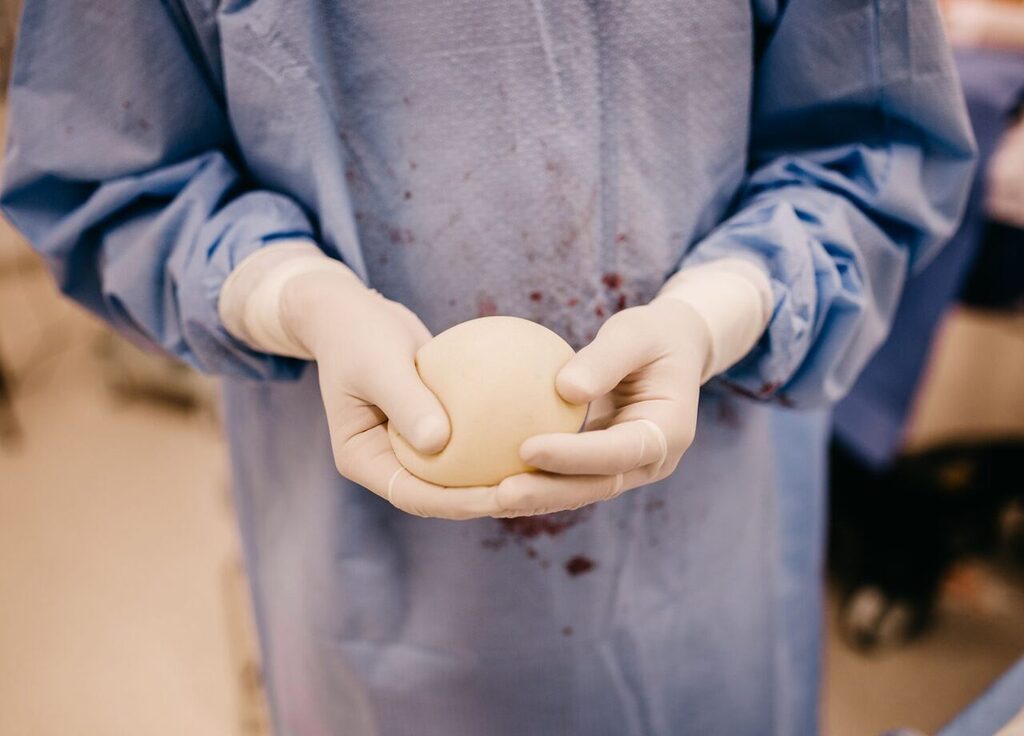
This is the most misunderstood point. Patients ask: “If we put in an implant, will it lift?” The answer is usually no. An implant gives volume and can correct mild pseudoptosis; but if the nipple sits below the inframammary fold, an implant placed beneath it will not move it up. On the contrary, by adding weight it increases sagging over time. For these patients an implant alone is the wrong operation.
Conversely, a lift is not enough for every patient. If there is little breast tissue, the upper half is empty and the patient wants cleavage fullness, lifting alone brings disappointment; the breast is higher but looks “small and flat”. The decision comes down to three questions: Where is the nipple? Is there tissue in the upper half? What does the patient want? The first question decides the lift; the second and third decide the implant. If an implant is chosen, we cover size, shape and placement in detail in our article on implant selection.

Where does the scar sit, and when does it fade?
There is no scarless lift, and we say so from the start. Depending on the technique, the scar runs only around the areola, around the areola plus a vertical line, or around the areola plus vertical plus the inframammary fold. The scar around the areola is the least visible because it sits at the border between dark and light skin. The vertical scar is red and raised for the first three months, pink at six months and thin and white after a year. The scar under the breast hides in the breast’s shadow.
How a scar heals is fifty per cent technique and fifty per cent care. Silicone gel or tape, sun protection and avoiding movements that stretch the scar for the first six months make a clear difference to its colour and thickness. We describe how scars change month by month, and which care actually works, with a photo timeline in our article on surgical scars.
Breastfeeding, sensation and future pregnancy
In a lift the nipple is moved together with its ducts and blood vessels, attached to the tissue beneath; it is not cut off and reattached. For this reason most of the milk ducts are preserved and most patients can breastfeed after surgery. Even so, no surgeon can guarantee breastfeeding one hundred per cent; with very large repositioning and in operations combined with a reduction, milk supply may be lower. For patients planning children soon we ask, where possible, to wait until six months after birth and the end of breastfeeding. The reason is not only breastfeeding: pregnancy enlarges and empties the breast again and can undo the result of the operation.
Nipple sensation decreases in the first weeks, or the opposite, increases. In most patients it returns to normal within three to six months; a small number may have a permanent reduction. We discuss this risk openly before surgery, because for some patients loss of sensation is an unacceptable price, and that information can change the technique.

The recovery timeline: what happens when?
The operation takes two to three hours under general anaesthetic, and the patient usually goes home the same day or the next morning. A sports-style surgical bra is fitted on day one; it stays on day and night for six weeks. Pain takes the form of tightness and fullness for the first three days and settles with simple painkillers. Swelling goes down in the second week, and in the first months the breast sits “too high and pointed”. This is normal; in a lift the breast is deliberately left slightly high, because it settles a little over the first three months and takes its true shape at six months.
A desk job can be resumed after one week, a job on your feet after two. Walking starts from day one, light exercise from week four, running and weights after week six. Sleeping on your back is compulsory for the first six weeks; sleeping face down compresses the breast and can spoil the shape. The sutures are dissolvable and are not removed. You can find what to expect day by day in our article on recovery after breast surgery.

Is the result permanent?
A lift does not stop gravity; it turns the clock back. The repositioned tissue and tightened skin stay in place, but ageing and weight changes continue. In a patient who keeps her weight, does not become pregnant and supports her breasts, the result is largely preserved for ten to fifteen years. With large, heavy breasts, very loose skin and frequent weight changes this period shortens. That is why, when severe sagging comes with a large breast, we suggest some reduction as well as a lift; a lighter breast stays in place longer.
In lifts with implants, the life of the implant is a separate matter; implants are not placed once and kept for life. We explain when they need replacing in our article on how long implants last.
What to know before your consultation
- Sagging is measured by the nipple’s position relative to the inframammary fold; there are three grades.
- Grade one uses the periareolar technique, grade two the lollipop, grade three the inverted T.
- An implant does not correct sagging; it is added to a lift if the upper half is empty.
- There is no scarless lift; the scar becomes a thin white line after a year.
- Breastfeeding is preserved in most patients; if children are planned, surgery is postponed.
- Surgical bra for six weeks, sleeping on the back for six weeks, final shape at six months.
- Stable weight and a supportive bra keep the result for ten years and more.
Three things we need to discuss before surgery
First, expectations. A lift raises and tightens the breast; if you want cleavage fullness or one or two cup sizes more, that is the implant’s job and must be discussed separately. Second, the scar. What determines the technique is the degree of sagging, not the wish to avoid a scar. Applying the periareolar technique to grade three sagging “to keep the scar small” brings both an inadequate result and a worse scar. Third, timing. If your weight has changed in the last six months, if you plan a pregnancy or if you smoke, the operation is postponed; because smoking impairs skin circulation, it is the biggest cause of scar and nipple problems in lift surgery. We list the situations in which we do not operate openly in this article.
You can find all the procedures we perform in breast surgery, and our approach, on our breast aesthetics page.
Frequently asked questions
What is breast lift surgery?
It is the operation that moves sagging breast tissue upwards, brings the nipple above the inframammary fold and removes excess skin. Its medical name is mastopexy. It adds no volume; if volume is wanted, it is combined with an implant.
Who is a candidate for a breast lift?
Patients whose nipple sits level with or below the inframammary fold, whose skin has loosened, whose weight has been stable for six months and whose family planning is complete. In pseudoptosis and mild volume loss an implant may be the better choice instead of a lift.
Does a breast lift leave a scar?
Yes, there is no scarless method. Depending on the technique the scar runs only around the areola, around the areola plus a vertical line, or in an inverted T. It is red for the first three months, pink at six months and a thin white line after a year.
Can I breastfeed after a breast lift?
In most patients, yes. Because the nipple is moved together with its ducts, most milk ducts are preserved. With very large repositioning and in operations combined with a reduction, milk supply may be lower; there is no guarantee.
Is an implant necessary for a lift?
No. An implant is added only if the upper half of the breast is empty and the patient wants fullness. An implant alone does not correct sagging; on the contrary, by adding weight it increases it over time.
When can I exercise after a breast lift?
Walking from day one, light exercise from week four, running and weights after week six. A supportive sports bra is worn for six months.
Is the result of a breast lift permanent?
The repositioned tissue stays in place, but ageing and weight changes continue. In a patient who keeps her weight and supports her breasts the result is largely preserved for ten to fifteen years. Pregnancy and major weight change shorten this period.
How long does breast lift surgery take, and when do I go home?
It takes two to three hours under general anaesthetic. The patient usually goes home the same day or the next morning; back to a desk job after one week and to exercise after six weeks.
Which technique is right for you?
The degree of sagging, the quality of your skin and your expectations become clear within a few minutes in consultation. Let us discuss together whether you need an implant, where the scar will sit and the right timing for you.