Body mass index is the first number we work out in consultation, from your height and weight. We never decide anything on it alone, but it is where the conversation about which operation, when, and how safely, begins. Use the calculator below to find your own value in seconds, see the healthy weight range for your height, and read what your result means from a cosmetic surgery point of view.
- Healthy weight range for your height
- —
- Waist-to-height ratio · waist risk
- —
What does this mean for cosmetic surgery?
This tool is for information only and is not a diagnosis. Results may be misleading in pregnancy, athletes and people with high muscle mass.
What is body mass index and how is it calculated?
Body mass index, BMI for short, is a simple ratio of weight to height. The World Health Organization’s classification for adults is based on it. The formula is:
BMI = weight (kg) ÷ height (m) × height (m)
Example: for someone weighing 70 kg at 1.70 m, 70 ÷ (1.70 × 1.70) = 24.2. That falls in the healthy weight range.
The result is only as good as the measurement. Weigh yourself in the morning, after the toilet, before eating and in light clothing; a swing of up to two kilos over the day is normal. Measure your height without shoes, standing straight with heels, buttocks and back against a wall. In consultation, about half the patients who give an “approximate” height turn out to be two or three centimetres out, which can move the result by a whole category.
What do BMI values mean?
In adults, BMI is read in six ranges. The cut-offs are the same for women and men.
| BMI | Category |
|---|---|
| Below 18.5 | Underweight |
| 18.5 – 24.9 | Healthy weight |
| 25 – 29.9 | Overweight |
| 30 – 34.9 | Obesity (class I) |
| 35 – 39.9 | Obesity (class II) |
| 40 and above | Severe obesity (class III) |
These limits come from data on populations of European origin. People of Asian origin carry more internal fat at the same BMI, so some guidelines place overweight from 23 and obesity from 27.5.
Healthy weight chart by height
“How much should I weigh?” has no single answer; every height has a range that counts as healthy. The chart below shows the weight range that keeps BMI between 18.5 and 24.9. If your height falls between the rows, the calculator above gives the exact range.
| Height | Healthy weight | Height | Healthy weight |
|---|---|---|---|
| 150 cm | 41.6 – 56.0 kg | 175 cm | 56.7 – 76.3 kg |
| 155 cm | 44.4 – 59.8 kg | 180 cm | 59.9 – 80.7 kg |
| 160 cm | 47.4 – 63.7 kg | 185 cm | 63.3 – 85.2 kg |
| 165 cm | 50.4 – 67.8 kg | 190 cm | 66.8 – 89.9 kg |
| 170 cm | 53.5 – 72.0 kg | 195 cm | 70.3 – 94.7 kg |
The width of the range is striking: for someone 165 cm tall it spans seventeen kilos. So “ideal weight” is not one number but the point in that range where you feel well, given your frame, muscle mass and age.
What BMI does not tell you
BMI only looks at total weight; it cannot tell whether that weight is fat, muscle or bone. That makes it misleading in some groups, and in consultation we always read it alongside other measurements.

A man who lifts weights regularly may come out as “overweight” purely because of muscle, with a low fat percentage. The opposite also happens: a slim-looking person who never exercises can sit in the healthy range with a lot of abdominal fat. This “skinny fat” picture is common in liposuction consultations. Over 65, slightly higher values are normal because muscle mass falls. BMI is not calculated in pregnancy; the pre-pregnancy value is used. Under 18, the value is read on percentile charts for age and sex; the adult table does not apply to children.
Waist circumference: the measurement BMI leaves out
Where fat sits matters more than how much there is. Fat stored around the abdominal organs is far more strongly linked to diabetes and heart disease than fat on the hips and thighs. The easiest way to see it is the waist measurement.
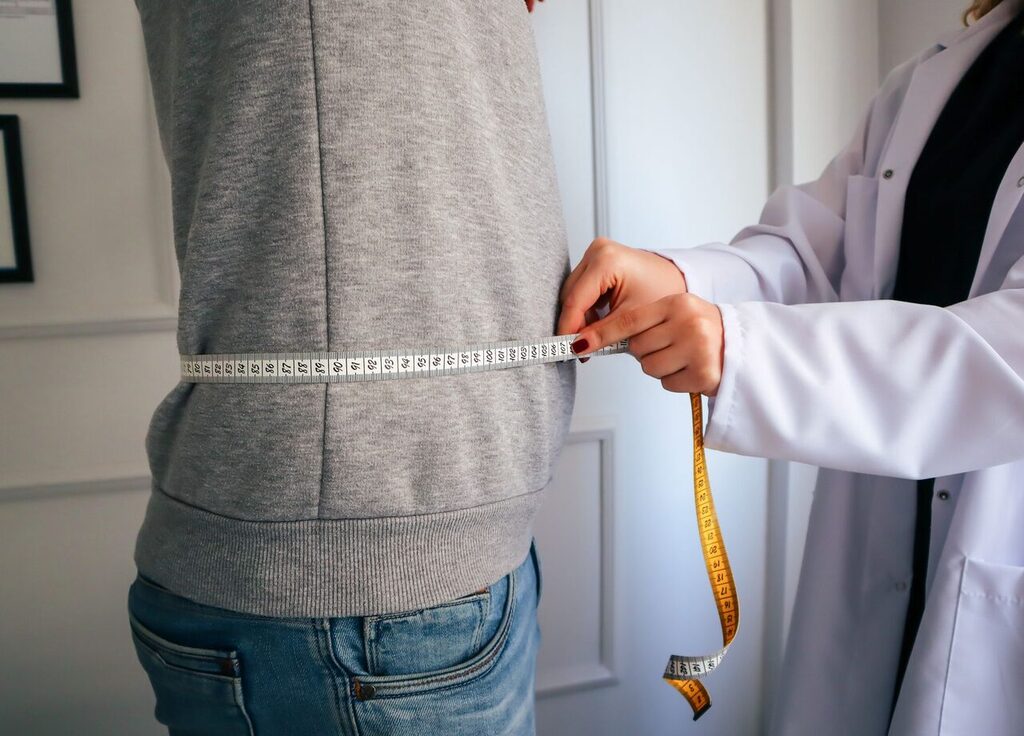
A waist above 80 cm in women and 94 cm in men means increased risk; above 88 cm and 102 cm, substantially increased risk. There is an even simpler rule: your waist should be less than half your height. A waist-to-height ratio under 0.5 is good, 0.5 to 0.6 calls for attention, and above 0.6 means high risk. Enter your waist in the calculator and it will work out the ratio for you.
How does a high BMI affect health?
As BMI rises, type 2 diabetes, high blood pressure, raised cholesterol, sleep apnoea, fatty liver and knee and back pain become clearly more common. Those are long-term problems, but there is also a side that shows up immediately on the operating table: the airway is harder to manage under anaesthesia, the risk of clots rises and wounds heal more slowly.

The good news: losing just five to ten per cent of body weight measurably improves blood pressure, blood sugar and cholesterol in someone who is overweight or obese. The goal is not to reach an “ideal weight” in one go, but to lose those first five or ten kilos that make a real difference to health.
Why BMI matters so much in cosmetic surgery
In body contouring operations such as liposuction, tummy tuck and arm or thigh lifts, BMI determines both safety and the result. In our own practice we work within this framework:
BMI below 30: suitable for most operations
In this range most liposuction, tummy tuck and breast operations can be performed safely. The best results come in patients close to their target weight whose weight has been stable for at least six months. Liposuction suits localised fat that resists diet and exercise; a tummy tuck suits loose skin after pregnancy or weight loss. We explain the difference in detail in our article comparing liposuction and tummy tuck.
BMI 30 to 35: an individual decision
Surgery is possible here, but the decision is made in consultation, based on general health, fat distribution and goals. We recommend a few months of weight management first to most patients. Risk is only part of the reason: a tummy tuck done before excess weight is lost loosens again with every five kilos lost later. A short wait means a far more lasting result.
BMI above 35: weight first, shape later
In this range we do not perform most cosmetic operations because of the risk of complications. First comes a weight-loss plan, with an obesity surgery assessment if needed. Once the weight is lost and has been stable for at least six months, lifts for the remaining excess skin on the abdomen, arms and thighs can be planned. You can read why surgery is postponed in which situations in this article.
You can watch Op. Dr. Bilgehan Aydın explain how a tummy tuck is performed in this short video (in Turkish):
How to reach a healthy BMI
Our advice to patients who want to lose weight before surgery is simple, but it takes patience: half a kilo to a kilo a week, two to four kilos a month. Weight lost faster is largely water and muscle and comes back just as quickly. Crash diets right before surgery leave the body short of protein and slow wound healing.

What works is well known: fill half the plate with vegetables, have protein at every meal, give up sugary drinks, walk seven or eight thousand steps a day and sleep at least seven hours. Keeping the weight off for three to six months after losing it matters as much for a lasting surgical result as losing it in the first place. After liposuction, too, the result lasts for years if your weight stays stable.
Ask yourself before surgery
- Is my BMI below 30? If not, let us plan weight management first.
- Has my weight stayed within two or three kilos for at least six months?
- Is my waist less than half my height?
- Am I planning a big weight change or a pregnancy in the coming months?
- Is what I want to change excess fat, loose skin, or both?
Frequently asked questions
What should my BMI be?
In adults, 18.5 to 24.9 is considered healthy. 25 to 29.9 is overweight and 30 and above is obesity. Over 65, values of 23 to 28 can be regarded as normal.
Is BMI calculated differently for women and men?
No. The formula and the ranges are the same. The difference lies in the waist: the risk threshold starts at 80 cm in women and 94 cm in men.
What is a healthy weight for someone 170 cm tall?
At 170 cm, the healthy weight range is 53.5 to 72 kg, which keeps BMI between 18.5 and 24.9. Where you feel best within it depends on your frame and muscle mass.
Can someone with a BMI of 30 have liposuction?
Possibly, but the decision is made in consultation. Between 30 and 35, general health, fat distribution and weight stability are assessed; a few months of weight management first often lowers the risk and improves the result. Liposuction is a shaping procedure, not a weight-loss method.
What BMI is needed for a tummy tuck?
The safest and most lasting results come with a BMI below 30 and a weight that has been stable for at least six months. Above 35, surgery is usually postponed until after weight loss.
How is BMI assessed in children?
The calculation is the same but the interpretation differs. Under 18, the result is read on percentile charts for age and sex. The adult table should not be used for children.
Why is BMI misleading in athletes?
Because BMI cannot tell muscle from fat. Someone with a lot of muscle can come out as overweight despite a low fat percentage. Waist circumference and body fat measurement give more accurate information.
Is BMI calculated during pregnancy?
No. The pre-pregnancy BMI is used, and the recommended weight gain in pregnancy is set according to it.
Which operation does your result suit?
Your BMI, waist and goals, taken together, show the right path for you. Send us your result on WhatsApp or book a consultation, and we will talk it through.