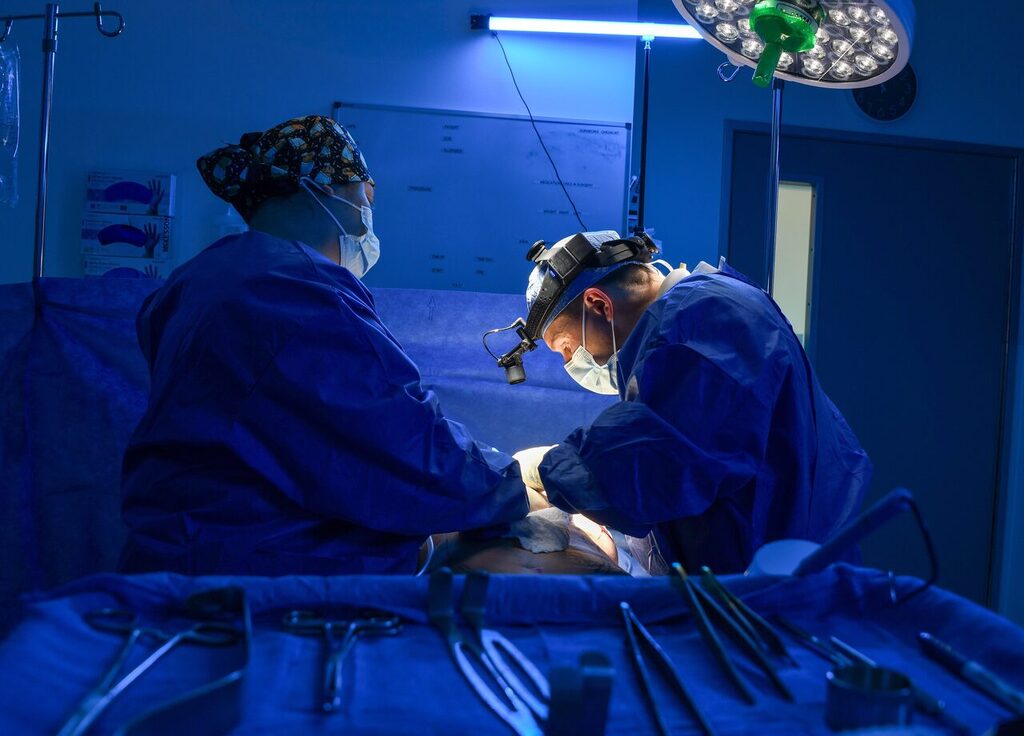
Once patients have decided to go ahead, the questions on their mind are rarely about the operation itself. They’ve already handed that part over to us. What they really want to know is what comes afterwards: “How much will it hurt? When can I go back to work? Can I pick up my child? When can I fly home?” We put this article together from the questions we hear most often at follow-up appointments. You can read it as a timeline, but let’s be clear from the start: every body heals at its own pace. The timings here are averages, and your own surgeon’s instructions always come first.
Surgery day and the first night
Breast augmentation is done under general anaesthetic and takes about an hour to an hour and a half. When you wake up, you’ll feel pressure and fullness across your chest; most patients describe it as “someone sitting on me.” It’s tightness rather than sharp pain. If the implant was placed under the muscle, this feeling is a little stronger, because the muscle is adjusting to the new volume.
Most of our patients stay one night in hospital. Not because it’s compulsory, but because the first night is the least comfortable one and having someone nearby helps. The next morning we check the dressings, get you on your feet for a few steps and send you home. If drains were placed, they usually come out at the first follow-up on day two or three; not every patient needs them.
The first week: slow, but on your feet
The first three days are the hardest part. Take your painkillers on schedule and don’t skip doses because you think you can manage; it’s much harder to bring pain down once it has started than to stay ahead of it. We ask you not to lift your arms above shoulder height, so for the first few days you’ll need help with things like reaching into cupboards or tying your hair up. Clothes that button or zip at the front are a lifesaver during this period; wear nothing that goes over your head.
Walking is allowed, in fact we encourage it. Getting up and moving around the house once an hour lowers the risk of clots and reduces swelling. Showering is usually possible from day two or three, depending on the type of dressing and your surgeon’s instructions. Baths, swimming pools and the sea are off limits until the incisions have fully closed, which means at least four weeks.
If you have a desk job, you can go back around day four or five. If you work on your feet or your job involves physical effort, wait two weeks. For driving, the rule is simple: if you’re no longer taking painkillers and can turn the wheel comfortably in a sudden manoeuvre, you can drive. For most patients that’s about a week.

Sleeping position: the thing everyone complains about
Let’s be honest, the most complained-about part of this period isn’t the pain, it’s the sleep. We ask you to sleep on your back for four to six weeks. If you’re a side sleeper, the first few nights will be a struggle. Propping yourself up on two or three pillows in a semi-sitting position helps; a pillow under each arm stops you from rolling over. Sleeping on your stomach isn’t even up for discussion for two months. The implants haven’t settled yet, and weight on one side in the early period can make the two sides heal differently.
The bra question: which one, and for how long?
You leave the operating theatre already wearing a special support bra: front-fastening, no underwire, with a wide band. You need to wear it day and night for the first four weeks, then during the day only for the next four. Its job is to hold everything still, so the implants settle in place as the swelling goes down without shifting. We wait at least six weeks, usually eight, before allowing underwired bras. The wire sits exactly along the incision line, so early on it rubs against the scar.
A frequent question: “How long should I wait before buying new bras?” At least three months. Your size keeps changing as the swelling subsides and the implants settle; bras bought early almost always turn out to be wrong.

Weeks two and three: swelling goes down, impatience sets in
By the end of the first week the pain has largely gone and given way to tenderness. During this period the breasts sit higher and firmer than they eventually will; the upper part looks full and the lower part looks empty. This is completely normal. These are exactly the weeks when patients call in a panic saying “they’re too high, they’re too hard.” The implants haven’t dropped yet and the muscle hasn’t relaxed.
Your nipples may feel numb, or the opposite, oversensitive. Sometimes even the brush of clothing is uncomfortable. This is the nerve endings recovering, and it usually returns to normal within weeks. Any small bruises fade within two weeks.
Light housework, short walks and a gentle daily routine are all fine at this stage. If you have small children, leave the lifting to someone else for the first two weeks; after that, start seated, letting the child climb onto you rather than lifting them.
When can I exercise?
There’s a clear order to this. After two weeks, brisk walking. After four weeks, lower-body exercises, a stationary bike and light jogging, as long as the chest isn’t being jolted. After six weeks, with approval at your check-up, swimming and upper-body work. For exercises that directly load the chest muscles, such as push-ups, bench press and flyes, we wait at least eight weeks, and sometimes twelve for implants placed under the muscle. Pilates and yoga follow the same rule; poses that strain the chest come last.
When you return to exercise, a good sports bra is essential. Choose high-support models with a clasp that hold each breast in a separate cup. For activities like running, this is the single most important thing for protecting the long-term position of the implants.
Flying, and patients who travel to us
A large share of our patients come from other cities and from abroad, so “when can I go home” is a routine question for us. For short domestic flights, five to seven days after surgery is enough. For long international flights, we usually give the go-ahead from day seven, after the first follow-up, once we’ve seen the state of the stitches and incisions. Wear your support bra on the flight, drink plenty of water, get up and walk the aisle every hour, and let someone else carry your hand luggage. Cabin pressure does not harm implants, so there’s no need to worry about that.

Scars: what happens over the first year
The scar starts as a four-to-five-centimetre line in the fold under the breast. It’s pink in the first month and may darken and thicken slightly in months two and three; this is the most active phase of healing and the one that worries patients most. From the sixth month it begins to fade, and by the end of a year it has become a thin, skin-coloured line in most patients.
There are three things you can do during this time. First, keep it out of the sun; a scar exposed to sunlight in the first year can darken permanently. Second, use the silicone strips or gel we recommend regularly once the stitches are out. Third, don’t smoke; nicotine reduces blood flow to the tissue, which both slows healing and worsens scar quality.
Months three to six: the real result
What we call “drop and fluff” is largely complete around the third month. The implants settle downwards, the lower pole fills out, the breasts soften to the touch and finally take on their natural position. That’s why we ask patients to wait three months before judging the result. By six months we can talk about a finished result; this is when we take the follow-up photographs.
The two sides can settle at different speeds in the early months; one goes ahead and the other catches up a few weeks later. This asymmetry is temporary and usually disappears by month three. If a noticeable difference persists beyond three months, we assess it at your check-up.
When should you call without waiting?
The rest of this article is about patience; this part is the opposite. If you notice any of the following, don’t wait for your next appointment, call straight away: sudden swelling and firmness on one side, especially if it’s clearly different from the other; a temperature above 38°C; redness, warmth or discharge along the incision; pain that doesn’t settle and doesn’t respond to painkillers. Most of these turn out to have simple causes, but the situations that need to be seen early hide among them.
One last note: the timings in this schedule are averages built up over years. Placement over or under the muscle, implant volume, your age and the character of your tissue all change the pace. It’s entirely normal for two patients operated on the same day to differ, with one out walking in the first week and the other staying home until the second. Measure yourself against your own previous week, not against other people; that’s how recovery is judged.