
For most patients who come in for breast reduction surgery, the problem does not start in front of the mirror. It starts in the evening, when the bra comes off: strap grooves on the shoulders, neck and back pain that never quite goes, a rash under the breasts every summer, shortness of breath during exercise, and the rule of always buying tops one size up. Large breasts, contrary to what most people assume, are a weight problem before they are a cosmetic one. In this article we explain who breast reduction is for, how many cup sizes you can expect to lose, where the scar sits, whether breastfeeding is affected and whether the pain really goes away, in the order we explain it in consultation.
The medical name for breast reduction is reduction mammoplasty. Excess breast tissue and loose skin are removed, the nipple is moved upwards and the remaining tissue is reshaped. In other words, this operation is also a breast lift; the smaller breast is gathered and raised in the same session. When patients say “make it smaller, but don’t let it sag”, that is not a wish. It is the operation itself.
In this article
- Why large breasts cause problems: pain, rashes, posture and breathing
- Who is a candidate for breast reduction, and who is not
- How many cup sizes, how many grams
- Techniques: lollipop and inverted T, how the nipple is moved
- Where the scar sits and when it fades
- Breastfeeding, nipple sensation and future pregnancy
- Recovery: what happens day by day
- Does the back and neck pain really go away
Why do large breasts cause problems?
The weight of the breasts is carried by two thin straps on the shoulders and by the spine through the neck and back. In patients where each breast weighs more than a kilogram, that load means a posture tilted forwards all day long. Once posture goes, the neck muscles work in constant tension, the pain between the shoulder blades becomes chronic and permanent grooves form where the straps sit. Physiotherapy and exercise ease the picture a little, but as long as the weight itself stays where it is, the pain comes back.
The second problem is the skin. The fold under the breast sweats in summer, gets no air and is open to fungal infection. Most patients tell us they have been using powder and creams on this area for years. The third is restricted movement: running, jumping, even walking fast is uncomfortable, and not even a sports bra can hold the breasts still. The fourth is the part nobody talks about: the relationship with one’s own body. We often see women whose breasts grew early in their teens and who grew up with their shoulders rolled inwards, hiding behind loose clothes. The strongest effect of breast reduction surgery sometimes shows not in the pain, but in that posture.
Who is a candidate for breast reduction, and who is not?
There is no single cup-size threshold for breast reduction surgery. What matters is the proportion of the breasts to the body and the complaints the patient lives with. A D cup may cause no trouble in a tall, broad-shouldered patient, while the same size collapses the shoulders of a petite one. In consultation we first measure where the nipple sits in relation to the breast fold, look at skin quality and tissue density, and then listen to the complaints. In a patient with strap grooves, back pain, rashes and restricted movement, the decision is easy.
We discuss the two ends of the age range separately. In young patients we wait for breast development to finish, meaning no change in size for at least a year. At the other end there is no barrier: we have many patients in their sixties who lived with pain for years and say “I wish I had done this sooner”. For patients who are losing weight, we recommend that weight stays stable for at least six months, because a breast made mostly of fat shrinks on its own as weight comes off, and the surgical plan changes.
There are also situations in which we do not operate. In uncontrolled diabetes, active smoking and serious heart or lung disease we correct that picture first; smoking is the most serious source of risk in breast reduction because it compromises the blood supply to the nipple. Patients planning a pregnancy in the near future are advised to leave the operation until after birth and breastfeeding. We listed the situations in which we postpone surgery one by one in this article.
How many cup sizes, how many grams?
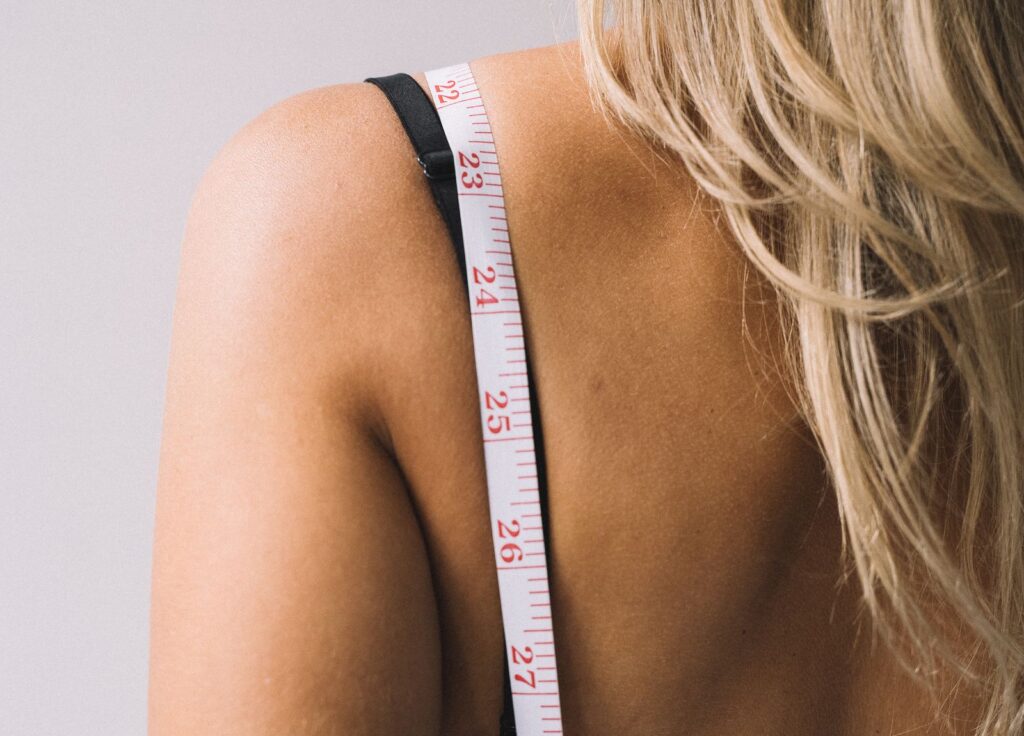
This is the question we hear most, and the answer is not a number but a proportion. The tissue removed from each breast usually ranges between three hundred and a thousand grams, which corresponds roughly to one to three cup sizes. But the goal is not “the smallest breast”; it is “the breast in proportion to the body”. A breast reduced too far looks out of keeping with the width of the shoulders, and the patient then experiences the opposite kind of dissatisfaction. That is why, instead of asking “what cup size do you want to be”, we ask “which clothes do you want to wear comfortably”; the answer is far more useful.
Another thing patients want to know is what the removed tissue actually is. It is gland, fat and skin. This tissue is routinely sent to pathology and examined; there are patients in whom early changes are found incidentally during breast reduction. For this reason we ask patients over forty for an up-to-date breast ultrasound or mammogram before surgery.
I always give the same answer to the cup-size question: your breasts will be reduced to fit your shoulders, your waist and your height, not your neighbour’s size.The sentence we say most often in consultation
Breast reduction techniques: which one, and when?
In breast reduction the technique is chosen according to how much tissue will be removed and how far the nipple needs to move upwards. In none of the techniques is the nipple cut off and stitched back on; it is slid upwards on a bridge of tissue together with its own blood vessels and milk ducts. Where this bridge is taken from, and the shape of the scar, define the technique.
Lollipop (vertical) technique: for moderate enlargement
This is our preferred method when less than five hundred grams will be removed and the nipple is not sitting very low. The scar starts around the areola and runs vertically down towards the breast fold; it is called the lollipop because of its shape. There is no horizontal scar in the fold under the breast. Because the breast is narrowed and gathered from the inside, the lifting effect is strong and the result holds for longer. We tell patients from the start that the vertical scar is noticeable in the first months and turns into a thin white line by the end of a year.
Inverted T (anchor) technique: for large, sagging breasts
When a lot of tissue has to be removed, the skin is loose and the nipple sits well below the breast fold, a horizontal scar along the fold is added to the vertical one. Most breast reductions are done with this technique, because most of the patients who come to us have a serious excess of tissue. It leaves the longest scar, but in a heavy breast it also gives the best shape. The horizontal scar under the breast stays in the breast’s own shadow and cannot be seen standing up.
Free nipple graft technique: for very large breasts
In the rare patients whose nipple has to move thirty centimetres or more and whose breasts each weigh more than a kilo and a half, the nipple cannot be carried on a tissue bridge; it is removed like a skin graft and placed in its new position. Sensation and breastfeeding are lost with this technique, so it is used only when no other option remains, and it is explained clearly to the patient beforehand.

Where does the scar sit, and when does it fade?
There is no scarless breast reduction, and we say so from the start. Depending on the technique, the scar runs around the areola plus a vertical line, or the same with a horizontal line added in the breast fold. The scar around the areola is the least visible because it sits on the border between darker and lighter skin. The vertical scar is red and slightly raised for the first three months, pink by the sixth month, thin and white by the end of a year. The scar under the breast is not visible in a neckline or a bikini.
How a scar heals depends half on surgical technique and half on care. Silicone gel or silicone tape for the first six months, sun protection and avoiding movements that stretch the scar make a visible difference to its colour and thickness. In patients with darker skin and in those with a family history of keloids we follow the scar more closely. We described how scars change month by month, and which care actually works, with a photographic timeline in our article on surgical scars.
| Period | How the scar looks | What to do |
|---|---|---|
| First three weeks | Red, slightly raised, tender | Sterile tape, keep dry, surgical bra |
| One to three months | Dark pink, a feeling of firmness is normal | Silicone gel or tape, sun protection |
| Three to six months | Pink, starting to soften | Continue silicone, light massage |
| One year and beyond | Thin, white, close to skin tone | Sun protection only |
Breastfeeding, nipple sensation and future pregnancy
In breast reduction the nipple is moved while still attached to the tissue beneath it, together with its ducts and vessels, so a significant part of the milk ducts is preserved. Most patients can breastfeed after surgery; however, milk supply may be reduced, and no surgeon can guarantee breastfeeding one hundred percent. The more tissue is removed and the further the nipple is moved, the lower this likelihood becomes. Patients who plan to have children soon are advised to wait until six months after birth and breastfeeding, where possible. The reason is not only breastfeeding: pregnancy enlarges the breasts again and can undo the result of the operation.
Nipple sensation is reduced in the first weeks, or on the contrary becomes oversensitive. In most patients it returns to normal within three to six months; in a small number there may be a permanent reduction. We discuss this risk openly before surgery, because for some patients loss of sensation is an unacceptable price, and that information can change the technique or the amount removed.
Recovery after breast reduction: what happens day by day?
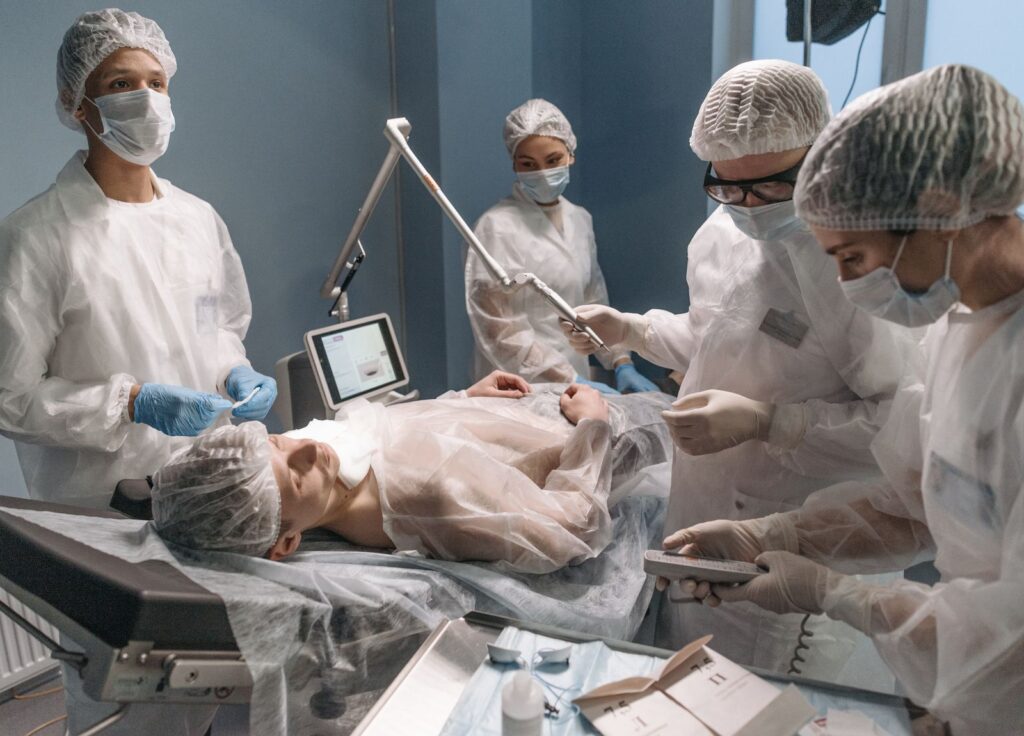
The operation is performed under general anaesthesia and takes two to four hours depending on how much is removed. Patients usually stay one night in hospital and go home the next morning. Most have a thin drain, which is removed within a day or two. On the first day a sports-style surgical bra is fitted; it stays on day and night for six weeks. Pain in the first three days feels like tightness and heaviness and is controlled with simple painkillers. Most patients say their back feels lighter the day after surgery; that feeling arrives before the swelling has even gone.
Swelling settles in the second week, and in the first months the breasts sit “too high and too full”. This is normal; the breasts are deliberately left slightly high, settle a little over the first three months and take their final shape at six months. You can return to a desk job after a week and to a job on your feet after two. Walking starts on day one, light exercise from the fourth week, running and weights after the sixth. Sleeping on your back is compulsory for the first six weeks. The stitches are dissolvable and are not removed. You can find what to expect day by day after breast surgery in our recovery article.

Does the back and neck pain really go away?

Yes, and this is the clearest gain of the operation. With the load gone, the shoulders open backwards, the neck muscles relax and the pain between the shoulder blades eases within weeks. The strap grooves on the shoulders disappear within a few months. The rash under the breasts, with less moisture in the fold, usually never comes back. In patients whose posture has been distorted for years, complete relief can take a few months as the postural muscles start working again; gentle back exercises during this period speed things up.
Breast reduction is one of the procedures with the highest patient satisfaction in all of aesthetic surgery. The reason is simple: the patient gains not only an appearance but a measurable relief in daily life. “I wish I had done this sooner” is the sentence we hear most often after this operation.
Is the result permanent?
The removed tissue does not come back. But the breast is living tissue; weight gain, pregnancy and ageing affect what remains. In a patient who keeps her weight stable and supports her breasts, the result is largely preserved for many years. With major weight gain the breasts can enlarge again, which is why weight stability is the single most important factor in how long the operation lasts. Some loss of the lifting effect over time is normal; occasionally a small correction may be needed years later.
Our videos on breast reduction and breast aesthetics
We share our approach to breast aesthetics, breast reduction and other operations, patient consultations and follow-up videos on our YouTube channel. In the video below we explain how we look at aesthetic surgery and what we expect from our patients.
For more videos, visit our YouTube channel.
What to know before your consultation
- Breast reduction is also a breast lift; the breast is made smaller and raised.
- Three hundred to a thousand grams are removed from each breast; the goal is proportion, not a cup size.
- The lollipop technique is used for moderate enlargement, the inverted T for large, sagging breasts.
- There is no scarless method; the scar becomes a thin white line by the end of a year.
- Breastfeeding is preserved in most patients but not guaranteed; if children are planned, surgery is postponed.
- One night in hospital, six weeks in a surgical bra, sport after six weeks.
- Back, neck and shoulder pain eases within weeks; weight stability protects the result.
- Patients over forty are asked for up-to-date breast imaging before surgery.
Three things we need to discuss before surgery
First, size. How much the breasts are reduced is decided by the proportion to shoulders, waist and height; over-reduction creates as much dissatisfaction as over-sized breasts. Second, the scar. The technique is dictated by the amount of tissue and the position of the nipple, not by the wish to avoid a scar. Using an inadequate technique on a heavy breast “to keep the scar short” produces both a poor shape and a worse scar. Third, timing. If your weight has changed in the last six months, if you are planning a pregnancy or if you smoke, surgery is postponed; smoking is the biggest cause of nipple complications in breast reduction.
You can find all the procedures we perform in breast aesthetics and our approach on our breast aesthetics page, and whether a lift alone is enough when the breasts sag in our breast lift article.
Frequently asked questions
What is breast reduction surgery?
It is the operation in which excess breast tissue and loose skin are removed, the nipple is moved upwards and the remaining tissue is reshaped. Its medical name is reduction mammoplasty. The breast becomes both smaller and lifted.
Who is a candidate for breast reduction?
Patients whose breast weight causes back, neck and shoulder pain, rashes under the breasts, restricted movement and poor posture, whose breast development is complete and whose weight is stable. There is no single cup-size threshold; what matters is proportion to the body.
How many cup sizes do you lose with breast reduction?
Usually three hundred to a thousand grams of tissue are removed from each breast, which is roughly one to three cup sizes. The goal is not the smallest breast but a breast in proportion to the shoulders and waist.
Does breast reduction leave scars?
Yes, there is no scarless method. The scar runs around the areola and vertically down (lollipop) or has a horizontal line in the breast fold added (inverted T). It is red for the first three months, pink by the sixth month and a thin white line by the end of a year.
Can you breastfeed after breast reduction?
In most patients, yes; because the nipple is moved together with its ducts, a significant part of the milk ducts is preserved. Milk supply may be reduced and it cannot be guaranteed. If children are planned soon, surgery is left until after birth and breastfeeding.
Does back pain go away after breast reduction?
Yes. With the load gone, the shoulders open, the neck muscles relax and the pain eases within weeks. Strap grooves on the shoulders disappear within a few months and the rash under the breasts usually never returns.
How long does breast reduction take, and how long is the hospital stay?
It takes two to four hours under general anaesthesia. Patients usually stay one night in hospital and go home the next morning. Return to a desk job after a week and to sport after six weeks.
Can the breasts grow back after reduction?
The removed tissue does not come back. However, major weight gain and pregnancy can enlarge the remaining tissue. In a patient who keeps her weight stable the result is largely preserved for many years.
At what age can breast reduction be done?
At any age once breast development is complete, meaning no change in size for at least a year. There is no upper age limit; with good general health it is performed safely over the age of sixty.
Is it time to be free of the weight?
How many sizes you will lose, which technique suits you and where the scar will sit become clear within minutes in consultation. Let’s talk through your expectations, the timing and the right plan for you.